
Astigmatism2026-02-04T23:56:30+13:00

Explore astigmatism treatment options tailored to your eyes in Melbourne

Discover how tailored vision correction options can help focus light more accurately on the retina for clearer vision

Explore astigmatism treatment options tailored to your eyes in Melbourne

Discover how tailored vision correction options can help focus light more accurately on the retina for clearer vision

With astigmatism treatment, many people see more clearly and comfortably

Learn what astigmatism is, why it occurs, and the treatment options that may help reduce blurred or distorted vision
  • Astigmatism is a very common vision condition that affects many people worldwide.
  • It can occur on its own or alongside short-sightedness or long-sightedness.
  • Astigmatism is often present from birth but may change over time.
  • Some people have mild astigmatism and may not notice symptoms, while others experience blurred or distorted vision at all distances.
  • Regular eye examinations are important to detect astigmatism and monitor changes, especially if symptoms such as eye strain or headaches occur.
  • Astigmatism happens when the cornea or lens has an uneven shape. Instead of being perfectly round, the surface is shaped more like a rugby ball.
  • This causes light to focus at multiple points instead of one clear point on the retina, leading to blurred or distorted vision.
  • Genetics can play a role, and astigmatism often runs in families. It can also develop after eye injury, surgery, or certain eye conditions.
  • The degree of astigmatism varies from person to person and can change over time.
  • Astigmatism is diagnosed during a comprehensive eye examination.
  • Vision tests measure how clearly you see at different distances. Specialised instruments are used to map the shape of the cornea and measure how light focuses inside the eye. These tests help determine the type and level of astigmatism.
  • Eye drops may be used to relax the focusing muscles for more accurate results.
  • Regular eye checks help track changes and support long-term eye health.
  • Astigmatism can be managed with glasses or contact lenses to improve vision clarity.
  • For suitable adults, laser eye procedures such as Customised LASIK or PRK may be considered to reshape the cornea and correct irregular curvature.
  • In some cases, lens-based procedures may also be discussed.
  • The most appropriate option depends on eye health, prescription, and lifestyle. A detailed eye assessment is required to determine suitability and to explain potential benefits, limitations, and risks.

Is astigmatism serious?
Astigmatism is common and usually manageable with proper vision correction.

Can astigmatism get worse over time?
It can change over time, especially during growth or after eye surgery or injury.

Do glasses cure astigmatism?
Glasses correct vision while worn but do not change eye structure.

Is laser eye surgery an option for astigmatism?
Laser eye surgery may be suitable for some adults after assessment.

How often should astigmatism be checked?
Regular eye exams are recommended, especially if symptoms change.

Clearer vision in 3 simple steps

From your first assessment to life after treatment, we’ve made the journey as straightforward as can be

Step 1: GET IN TOUCH

Not everyone is suitable for laser vision correction. The first step is to find out if treatment could help you. Call our friendly team or use our online calendar to book a free appointment.
Step 2: WE’LL MEET

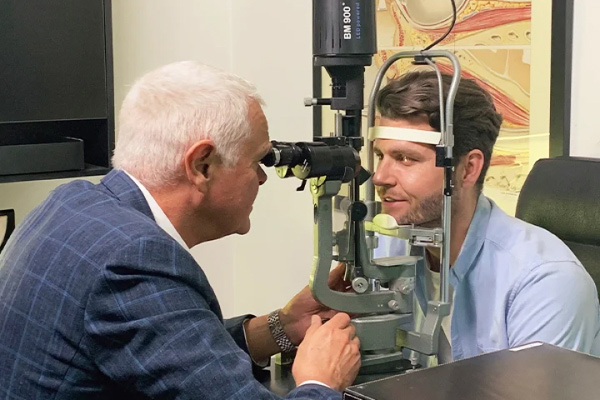
At your appointment, we’ll examine your eyes, answer your questions, and give you an honest recommendation based on your needs. You’ll leave with a clear understanding of the best options for you.

Step 3: ENJOY THE BENEFITS

After treatment, many people are surprised at how quickly daily life becomes easier. From driving to travelling to enjoying sport, you could experience freedom without glasses or contacts.

Freedom from glasses can start with one appointment

Find out if laser eye surgery is right for you

Book your free laser eye assessment and learn if clearer vision is within your reach

Get your questions answered about laser eye surgery in Melbourne

Explore expert insights and quick guides to help you understand treatment options, benefits, and what to expect right here in Melbourne

June is Cataract Awareness Month

Categories: News|

June is Cataract Awareness Month - to help educate the community about cataracts. About half of all Australians aged over 50 have some form of cataract and ageing is the most common cause.

Ready for life without glasses?

Ready for life without glasses?

Take our 2-minute quiz to see if laser eye surgery could suit you

Hi, I’m Dr Rick Wolfe.

I’ve been performing laser vision correction and cataract surgery in Melbourne since 1991, with more than 30,000 procedures completed.

As a Fellow of RANZCO, I’ve dedicated my career to advancing eye surgery techniques in Australia and internationally.

I regularly share my knowledge at global conferences and founded the World College of Refractive Surgery and Visual Sciences to support excellence in our field.

My goal is simple: to provide safe, precise, and personalised care that helps people enjoy clearer vision.

Every patient is unique, and I take pride in tailoring treatment to individual needs.

Dr Rick Wolfe

Owner, Founder and Surgeon at Vista Eyes Laser Eye Clinic
Ophthalmologist and Laser Eye Surgeon, MB BS, FRANZCO, FWCRS
Go to Top